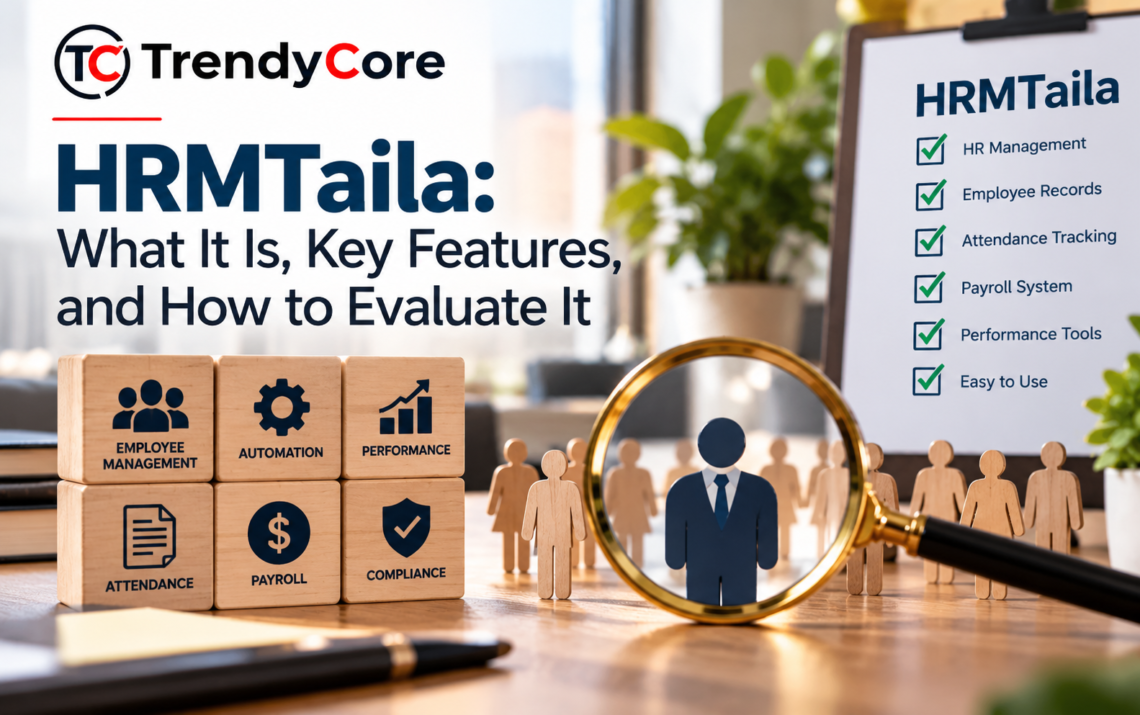
Search for a new HR tool, and you may stumble on an odd name. HRMTaila is one of them. Some blogs call it a next-generation, AI-driven human resource management system. However, you will not find a clear company, price list, or login page behind the name. So what is really going on? In this guide, you will learn what the term means, which features people link to it, and how to check any HR platform before trusting it with employee data.
What Is HRMTaila?
Online descriptions present HRMTaila as a modern HRMS, short for Human Resource Management System. In simple words, an HRMS is software that keeps employee records, payroll, hiring, attendance, and performance tools in one place.
According to the blogs that use the term, this platform stands out for three things. First, it promises heavy automation of routine HR work. Second, it offers data analytics for spotting hiring and retention trends. Third, it aims to personalize the employee experience.
Still, these are marketing-style claims. Most come from a handful of small websites, and none point to an official source. Therefore, it is wise to treat the name as a concept until a real vendor proves otherwise.
Is HRMTaila a Real Product? What We Could Verify
Let us be direct. During research, I looked for a company site, product demo, pricing page, and independent reviews. Unfortunately, none turned up. What appeared instead were a few blog posts, social media mentions, and generic HRMS articles.
Here is what that tells us:
- The name is used mostly in low-authority blog content.
- No trusted software review site lists it.
- No public pricing or free trial page exists.
- Feature lists across blogs are broad and repeat the same ideas.
This does not prove the tool is fake. Even so, it means you should not enter payroll data, employee IDs, or bank details anywhere until you confirm who runs the platform. If a vendor calls itself HRMTaila, ask for a company registration, a security document, and customer references first.
Features Commonly Linked to This Name
Since no official feature sheet exists, we can only list what the blogs claim. Below are the most repeated ideas.
Recruitment and onboarding. Some pages say AI filters match candidates by behavior and culture fit, not just keywords. In addition, they describe guided onboarding flows for new hires.
Performance and feedback. Several posts mention continuous pulse checks. Employees receive feedback on projects, while managers see team mood through sentiment tools.
Compliance and payroll. Blogs claim automated tax filing and benefit handling. Be careful here, though. One page promises 100 percent accuracy, which no honest software vendor can guarantee, because labor laws change often.
Global tools. Claimed extras include currency conversion for payroll, language localization for training, and time zone coordination.
Integrations. Descriptions mention connections to Slack, Microsoft Teams, and Google Workspace through APIs.
Claims vs What to Verify
| Claimed feature | What to ask or check |
|---|---|
| AI candidate matching | How is the model trained? Can you audit results for bias? |
| Automated compliance | Which countries and tax rules are covered? Who updates them? |
| Sentiment analysis | Is employee consent collected? Where is the data stored? |
| Global payroll | Which currencies and banks are supported? |
| API integrations | Is there public developer documentation? |
| Data security | Are there audit reports, encryption details, and access controls? |
Clearly, each shiny claim needs proof. A real vendor will answer these questions without hesitation.
Why Companies Move to HRMS Software
Whatever name is on the box, the demand for HR software is real. Trusted sources such as SAP describe an HRMS as a system that manages core HR work, including employee data, benefits, time and attendance, and payroll. It also supports talent tasks such as recruiting, onboarding, performance, learning, and succession planning.
As teams grow, spreadsheets stop working. For example, a company with 60 employees may track leave in one file, payroll in another, and reviews in email. As a result, errors creep in and HR staff spend hours on admin.
A proper HRMS solves this by:
- Keeping records in a single, searchable place
- Automating leave, attendance, and approvals
- Giving managers mobile access to team data
- Producing reports on turnover and performance
- Helping the company stay on top of labor rules
Because of this, the category is worth exploring. The key is choosing a vendor you can verify.
Pros and Cons of Adopting Any New HR Platform
Pros
- Less manual paperwork and fewer data errors
- Faster hiring and smoother onboarding
- Better visibility into turnover and engagement
- Self-service tools that free up HR time
Cons
- Setup and data migration can be slow
- Customization may cost extra
- Integrations with older systems can be difficult
- Poorly chosen tools may put employee data at risk
For an unverified name, the last point matters most. Payroll and personal records are sensitive, so security comes before features.
How to Evaluate Any HRMS in Six Steps
If you are shopping for HR software, follow this simple process.
- Define your needs. List the tasks that waste the most time, such as leave tracking, payroll, or hiring.
- Confirm the vendor. Look for a real company address, registration details, and named leadership.
- Check independent reviews. Sites like G2 or Capterra show feedback from actual customers.
- Request a demo and a trial. Test the tool with dummy data first.
- Review security. Ask about encryption, user roles, two-factor login, and where data is hosted.
- Read the contract. Look at pricing, renewal terms, data export rights, and cancellation rules.
Moreover, involve one HR person and one manager in the trial. They will spot workflow problems faster than any checklist.
Red Flags to Watch For
Sometimes a tool looks perfect on a blog but falls apart under questions. Watch for these warning signs:
- No company name, address, or contact person
- No public pricing or demo booking option
- Promises of perfect accuracy or guaranteed results
- Only blog mentions, with no independent reviews
- Requests for sensitive data before any contract is signed
- Feature claims copied word for word across several sites
If you spot two or more, pause and dig deeper.
Who Might Benefit From an HRMS Like This
Different teams need different levels of software. Small businesses under 50 people usually need attendance, leave, and basic payroll. Mid-sized companies often add recruitment and performance tools. Large organizations, on the other hand, need compliance, analytics, and multi-country support.
Similarly, remote teams gain a lot from self-service portals and time zone tools. Therefore, match the platform to your size and workflow, not to the loudest promise.
Frequently Asked Questions
What does HRMTaila mean?
Blogs use the name for an AI-driven HR management system. However, no official vendor or product page confirms this, so treat it as unverified.
Is there pricing for it?
No public price list was found. Consequently, any quote you receive should be confirmed in writing with a registered company.
Is an HRMS the same as an HRIS?
Not exactly. An HRIS stores core employee data, while an HRMS adds talent, performance, learning, and engagement tools.
How can I stay safe when trying new HR software?
Use test data first. Also, check reviews, confirm the company, and read the security terms before uploading real records.
Final Thoughts
To sum up, HRMTaila is a name that appears online with big promises but very little proof. Some blogs describe it as an AI-driven HRMS covering hiring, performance, compliance, and global payroll. Even so, no official company, pricing, or independent review backs those claims today.
Meanwhile, the need behind the search is genuine. Teams want cleaner HR processes, faster hiring, and better data. So, use the checklist above to test any vendor, whatever its name. If a platform passes on security, transparency, and support, it deserves a demo. If it does not, move on and pick a proven tool. In the end, your employees’ data is too important to trust to guesswork.
You may also Like: BackToFrontShow Pricing 2026: Plans, Costs, and Real Value




One comment on “HRMTaila: What It Is, Key Features, and How to Evaluate It”