Somewhere between “what is this website” and “what should I actually buy,” a lot of people searching droven io ai automation tools get stuck. They’ve seen the name somewhere maybe in an article, maybe in a forum thread and they’re not sure if it’s a product, a review site, or something else entirely.
Let’s settle that first, then get into the part that actually matters: how to choose an AI automation tool that fits your business without wasting a quarter figuring it out the hard way.
What Droven.io Actually Is (And Isn’t)
Droven.io is a content site. It publishes articles about artificial intelligence, automation, machine learning, and adjacent technology topics. There’s no software to download, no dashboard to log into, and no product demo waiting behind a signup form. If you’ve clicked through expecting a tool, you’ll find explanations instead which, honestly, is often more useful at the research stage.
Here’s the part worth being upfront about: details like who runs the site, how it’s funded, or whether it has any financial relationship with the tools it writes about aren’t publicly documented anywhere verifiable. That doesn’t automatically make the content untrustworthy, but it does mean you shouldn’t take editorial independence as a given. Treat those claims as unconfirmed until you find a primary source saying otherwise.
So when people search droven io ai automation tools, they’re usually really searching for two different things at once: what the site covers, and what “AI automation tools” even means as a category. Let’s take the second one seriously, because that’s where the real decision-making happens.
Traditional Automation vs. AI-Powered Automation
Before comparing tools, it helps to know what separates old-school automation from the AI-driven kind.
Traditional automation follows fixed rules. If a customer submits a support ticket containing the word “refund,” route it to the billing team. That’s it no interpretation, no nuance. It works fine until someone phrases their request differently, and the rule breaks.
AI-powered automation adds a layer of understanding. Instead of matching exact keywords, it interprets intent. A system built this way can tell the difference between someone asking “what’s your refund policy?” and someone saying “I want my money back right now” and route each one appropriately, even though neither contains an obvious trigger word.
That shift from rigid rules to contextual judgment is the whole reason this category has exploded over the past few years.
The Five Categories Worth Knowing
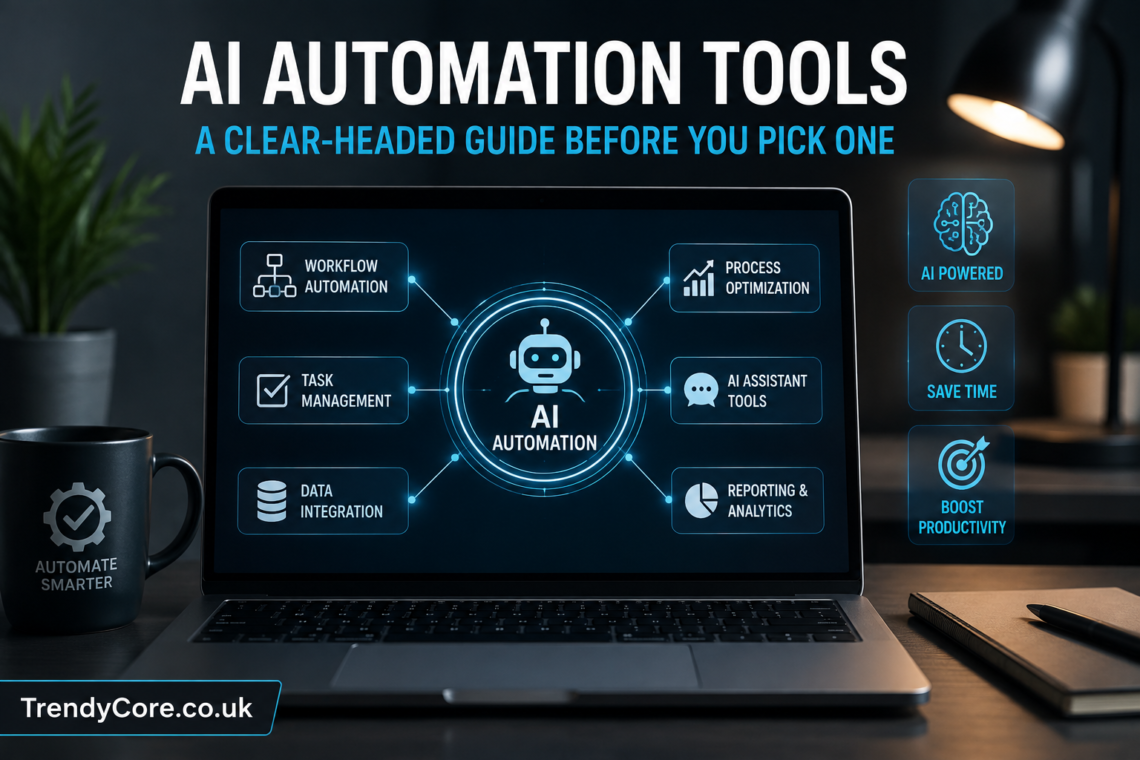
Most tools discussed under droven io ai automation tools fall into a handful of recognizable buckets. Knowing the category matters more than memorizing specific brand names, since tools within the same bucket tend to solve overlapping problems.
Workflow Automation Platforms
These connect separate apps and trigger actions between them submit a form, and a spreadsheet updates automatically while an email goes out. They’re the glue between tools that otherwise don’t talk to each other.
Conversational AI Systems
Chatbots and voice assistants built on large language models. Used heavily for customer support, lead qualification, and any task where a human would normally be answering the same handful of questions on repeat.
Robotic Process Automation (RPA)
This handles repetitive, screen-level tasks data entry, invoice matching, form processing. It doesn’t require judgment calls, just consistency at scale, which makes it a strong fit for back-office work.
AI-Enhanced CRM Platforms
Customer relationship management software with AI layered on top for lead scoring, follow-up suggestions, and predictive analytics that flag which prospects are worth chasing first.
RAG-Powered Knowledge Systems
Retrieval-Augmented Generation lets an AI model pull from a company’s own documents before generating an answer, rather than relying solely on general training knowledge. In practice, this means a chatbot that actually knows your product manual instead of guessing.
A Practical Look at the Tools Themselves
Here’s where theory turns into something you can actually act on.
Workflow tools split roughly into three tiers. Zapier remains the easiest entry point for non-technical teams, though costs climb fast at higher volume. Make (formerly Integromat) offers more visual branching logic, suited to moderately complex setups. n8n sits at the technical end open-source and self-hostable, which appeals to teams with development resources who want full control over their data and infrastructure.
CRM tools follow a similar spread. GoHighLevel bundles CRM, messaging, and pipeline management into a single system that service-based businesses tend to like. HubSpot layers AI-assisted scoring and drafting onto its existing marketing suite. Salesforce Einstein operates at a completely different scale, built for large sales organizations already running Salesforce — it’s overkill for a five-person team just getting started.
RPA platforms like UiPath dominate structured, high-volume back-office work in industries such as finance and healthcare. Microsoft Power Automate makes the most sense for organizations already embedded in the Microsoft 365 ecosystem; its value drops noticeably outside that environment.
Custom AI builds bespoke chatbots or document-retrieval systems trained on a specific company’s data require more upfront technical investment. They’re often the only real option when off-the-shelf tools produce answers too generic to be useful for a specialized business.
Quick Reference Table
| Tool Type | Example | Best Fit For | Technical Skill Needed |
|---|---|---|---|
| Workflow Automation | Zapier | Small teams, simple app connections | Low |
| Workflow Automation | Make | Multi-step logic, mid-size teams | Medium |
| Workflow Automation | n8n | Custom, high-volume integrations | High |
| AI CRM | GoHighLevel | Service businesses, lead follow-up | Low to medium |
| AI CRM | Salesforce Einstein | Large enterprise sales teams | High |
| RPA | UiPath | Back-office, regulated industries | High |
| RPA | Power Automate | Microsoft 365-based organizations | Medium |
| Custom AI | RAG pipeline | Company-specific knowledge bases | High |
Treat this as an orientation point, not a final ranking. Pricing and feature sets shift often, and what works well for one team can be the wrong fit for another with different technical resources.
How Businesses Actually Use These Tools Day to Day
The most common use cases show up in fairly predictable places:
- Lead capture and qualification: a form submission triggers a workflow tool, which scores the lead and routes it to the right sales rep automatically.
- Customer support automation: chatbots absorb routine, repeated questions, escalating only the genuinely complex cases to a human.
- Invoice and document processing: RPA tools extract and match data from incoming paperwork, cutting down manual entry hours.
- CRM follow-up automation: AI layers trigger reminders, draft outreach messages, or update records based on recent customer activity.
None of this requires exotic setups. A small business can implement a basic version of any of these with a handful of hours and a mid-tier subscription plan.
Pros and Cons of Adopting AI Automation Tools
Pros:
- Frees up staff time from repetitive, low-judgment tasks
- Scales more easily than hiring additional headcount for routine work
- Reduces human error in data-heavy processes like invoicing
- Many entry-level tools require no coding experience at all
Cons:
- AI systems can produce confident but incorrect answers, unlike traditional software that tends to fail more visibly
- Chained automations create dependency risk if one connected system breaks, others can fail silently
- Not every platform is built to handle regulated or sensitive data by default
- Poor setup and messy source data cause more failures than the tool itself does
Why Implementation Beats Tool Selection
Here’s something that gets overlooked constantly: most automation failures trace back to how a system was set up, not which platform got picked. A simple tool configured carefully will consistently outperform an advanced one thrown together in a rush. Before comparing feature lists, it’s worth spending real time mapping out the actual process you’re trying to automate.
How to Choose the Right Tool for Your Team
Start with the process, not the software. Identify the single task eating the most staff hours right now that answer usually narrows your search to one or two categories before you even open a comparison page.
From there, weigh three things honestly: your team’s technical comfort level, your budget for ongoing subscription costs, and how clean your existing data actually is. AI tools are only as useful as the information feeding them, and most organizations underestimate how much cleanup their CRM or document library needs before automation performs the way vendors promise in demos.
Finally, if you’re handling regulated data healthcare records, EU customer information, financial details confirm compliance certifications directly with the vendor. Don’t assume coverage just because a tool markets itself as “enterprise-ready.”
Final Thoughts
Anyone landing on droven io ai automation tools as a search term is usually caught between two questions: what is this site, and what tools should I actually consider? The site itself is a content platform, nothing more no product, no login, no dashboard. The tools it writes about, though, span a genuinely useful category worth understanding on its own merits.
Match the tool to your process, not the other way around. Start small, confirm your data is in reasonable shape, and scale up once the basics are working reliably. That approach beats chasing whichever platform ranks highest in someone else’s roundup including this one.
You may also Like: TechTrendery.com USA





2 Comments on “Droven Io AI Automation Tools: A Clear-Headed Guide Before You Pick One”