Social media never sits still. New platforms rise, algorithms shift overnight, and teams scramble to keep every channel updated without dropping the ball. That constant pressure is exactly why tools promising to simplify the process keep gaining attention and Crew CloudySocial is one of the names showing up more often in those conversations.
If you’ve searched for it, you’ve probably noticed something odd: not everyone describes it the same way. Some call it a cloud-based collaboration hub for marketing teams. Others frame it as an engagement network where creators support each other’s content. A few describe it as an AI-assisted scheduling and analytics platform. That inconsistency isn’t a red flag by itself it’s common with newer or fast-growing tools that different communities adopt for different reasons. This guide pulls those threads together so you leave with a clear, practical understanding of what the platform generally offers, who it tends to suit, and what to weigh before you commit time or budget to it.
What Is Crew CloudySocial?
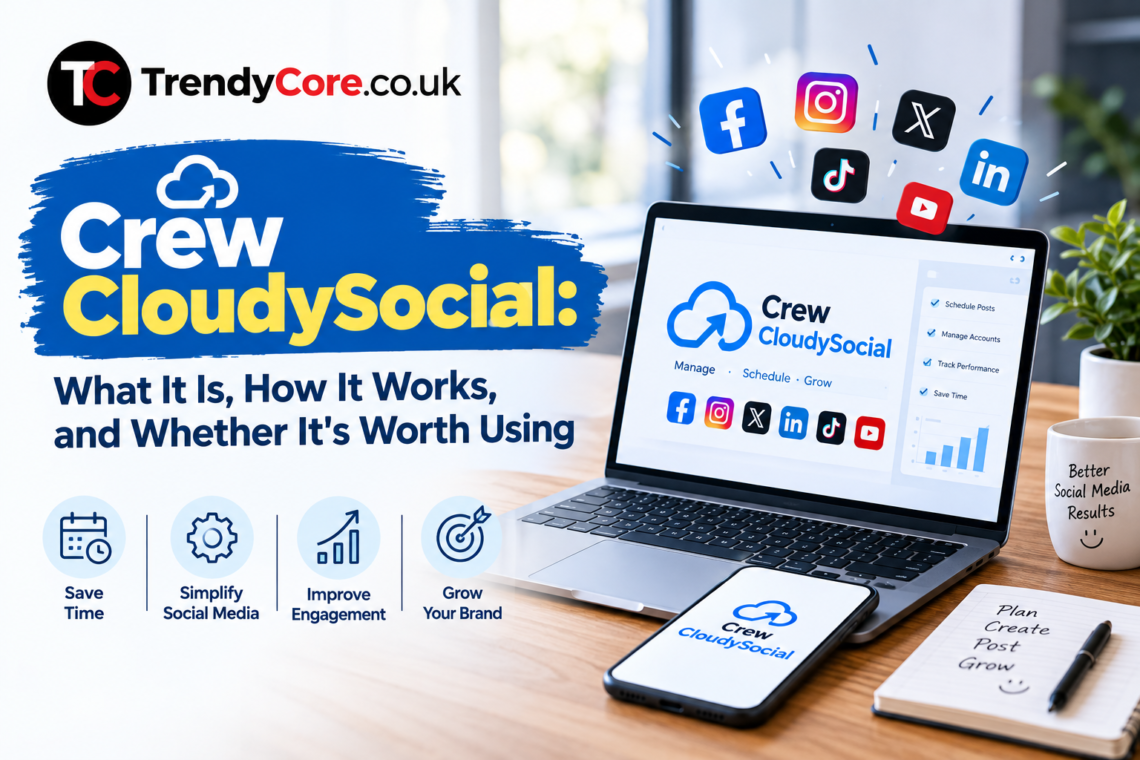
At its core, Crew CloudySocial is best understood as a cloud-based platform built around two ideas: organized social media management and structured team collaboration. Instead of juggling spreadsheets, scattered chat threads, and separate scheduling apps, the platform aims to bring planning, content creation, approvals, and performance tracking into one shared space.
The name itself hints at the concept. “Cloudy” points to its cloud-hosted nature nothing to install, everything accessible from a browser. “Crew” points to the collaborative side the idea that social media success today rarely comes from one person working alone. Content usually passes through several hands: a writer drafts it, a designer builds the visuals, a manager reviews it, and someone finally hits publish. Crew CloudySocial tries to make that handoff smoother.
Some descriptions also mention a community-engagement angle, where users interact with one another’s posts to boost visibility. Whether that’s a core feature or a secondary use case seems to depend on which version of the platform or which user community you encounter. Because the branding is still settling, it’s worth treating specific claims with a healthy dose of caution and verifying current features directly before signing up.
Why Crew CloudySocial Has Gained Attention
A few genuine industry problems explain the interest:
- Organic reach keeps shrinking. Algorithms on major platforms increasingly favor paid promotion, so unaided posts often struggle to reach followers.
- Teams are more distributed than ever. Remote and hybrid work means content approval can’t rely on someone walking over to a colleague’s desk.
- Multi-platform management is exhausting. Businesses rarely stick to one network they’re posting to Instagram, X, LinkedIn, TikTok, and more, each with different formats and timing needs.
- Manual tracking wastes time. Without a shared calendar or dashboard, it’s easy to lose track of what’s scheduled, what’s pending approval, and what already went live.
Crew CloudySocial positions itself as an answer to that chaos, promising a single dashboard instead of five disconnected tools.
Core Features You’ll Likely Encounter
While exact feature sets vary by source and possibly by plan tier, several capabilities come up repeatedly across descriptions of the platform.
Centralized Content Calendar
A visual calendar lets teams see everything scheduled across every connected channel at a glance. Drag-and-drop scheduling makes it easy to shift a post from Tuesday to Thursday without digging through settings menus.
Approval Workflows
Rather than emailing drafts back and forth, reviewers can comment directly on a post inside the platform. This keeps feedback attached to the content itself, so nothing gets lost in a crowded inbox.
Multi-Account Management
Teams managing several brands, clients, or channels can switch between accounts without logging in and out repeatedly a genuine time-saver for agencies.
Analytics and Reporting
Performance tracking helps teams understand which posts are working. Rather than pulling numbers manually from each platform’s native analytics, Crew CloudySocial aims to consolidate that data into one readable report.
AI-Assisted Content Suggestions
Some versions of the platform reportedly include AI tools that suggest captions, recommend posting times based on past engagement, or generate content ideas when a team is running low on inspiration.
Team Roles and Permissions
Structured roles writer, designer, manager, client help keep responsibilities clear, especially on larger teams where confusion about “who approves what” can slow everything down.
Who Crew CloudySocial Is Best Suited For
Not every tool fits every user, and that’s true here too. Based on how the platform is generally described, it tends to work best for:
- Small to mid-sized marketing teams who need shared visibility without enterprise-level complexity.
- Social media agencies managing multiple client accounts from one place.
- Content creators working with a small crew a designer, an editor, maybe a virtual assistant who need lightweight coordination.
- Startups that want an affordable, all-in-one option before investing in more expensive enterprise software.
Solo creators without a team might find some of the collaboration features unnecessary, while very large enterprises with complex compliance needs may eventually outgrow it and need a more specialized tool.
Crew CloudySocial vs. Traditional Social Media Tools
Here’s a simple comparison to put things in context against more established categories of tools.
| Feature | Crew CloudySocial | Basic Scheduler (e.g., a single-purpose posting tool) | Enterprise Suite |
|---|---|---|---|
| Team collaboration | Built-in approval workflows | Usually limited or absent | Extensive, often complex |
| Learning curve | Moderate | Low | High |
| Best for | Small-to-mid teams, agencies | Solo users | Large corporations |
| AI content help | Often included | Rarely included | Sometimes included |
| Pricing | Generally mid-range | Low | High |
| Multi-channel support | Yes | Sometimes limited | Yes |
This comparison is a general guide rather than a fixed rule actual pricing and feature depth can shift over time, so it’s worth checking current details before making a decision.
Pros and Cons
No tool is perfect for everyone, and weighing the trade-offs honestly matters more than chasing hype.
Pros:
- Combines scheduling, collaboration, and analytics in one dashboard, cutting down on tool-switching.
- Cloud-based access means teams can work from anywhere with an internet connection.
- Approval workflows reduce the back-and-forth of email-based content review.
- Reportedly beginner-friendly, with a design that doesn’t require deep technical knowledge.
- Useful for agencies juggling multiple client accounts.
Cons:
- Descriptions of the platform vary across sources, which makes it harder to know exactly what’s included before signing up.
- May lack some of the advanced customization found in long-established enterprise platforms.
- AI-generated suggestions, where included, still require human review for tone and accuracy.
- As a newer or less widely documented name, independent user reviews can be harder to find than for established competitors.
Is Crew CloudySocial Trustworthy?
This is a fair question to ask before adopting any newer platform, and it deserves a straight answer: verify before you commit. A few practical steps help here:
- Check the official site directly rather than relying solely on third-party summaries, since feature lists and pricing can change.
- Look for a free trial or demo before entering payment details, which is standard practice for legitimate SaaS tools.
- Read recent, dated reviews rather than older ones, since younger platforms evolve quickly.
- Confirm data-handling practices, especially if you’re connecting business social accounts with sensitive audience data.
None of this means the platform is untrustworthy it simply reflects sound practice for evaluating any tool that handles your brand’s public-facing accounts.
How to Get Started
If you decide to explore the platform for your own team, a simple rollout tends to work better than switching everything over at once:
- Start with one or two social accounts to test the workflow before migrating your entire channel list.
- Invite a small group of teammates first so you can iron out approval steps before scaling to the whole team.
- Build out your content calendar a few weeks ahead, rather than scheduling day by day.
- Review the analytics after two to three weeks to see whether the reporting genuinely reflects what’s working.
- Expand gradually to additional accounts and team members once the workflow feels natural.
Frequently Asked Questions
Is Crew CloudySocial free to use? Pricing details vary by source, and some describe tiered plans while others don’t specify cost at all. Check the current pricing page directly for accurate numbers.
Does it work for solo creators, or only teams? While it’s built with collaboration in mind, a solo creator can still use the scheduling and analytics features without needing a full team.
Can it replace multiple existing tools? For many small-to-mid-sized teams, yes it’s designed to consolidate scheduling, approvals, and reporting. Larger organizations with highly specific workflows may still need supplementary tools.
Is there a learning curve? Most descriptions suggest a moderate learning curve friendlier than enterprise suites, but not quite as simple as a basic single-purpose scheduler.
Final Thoughts
Crew CloudySocial reflects a broader shift happening across digital marketing: teams want fewer tabs open, fewer scattered conversations, and more clarity about what’s happening across their social channels. Whether it becomes your go-to platform depends on your team size, your current pain points, and how well the actual feature set matches what’s described here.
Before making a decision, take the sensible route try a demo, ask current users about their real experience, and compare it directly against whatever tool you’re using today. If the collaborative, all-in-one approach that Crew CloudySocial promises solves a genuine bottleneck for your team, it’s worth the test run. If your needs are simpler, a lighter scheduler might still serve you just as well.
You may also Like: Discount Codes LWMFHotels





One comment on “Crew CloudySocial: What It Is, How It Works, and Whether It’s Worth Using”