
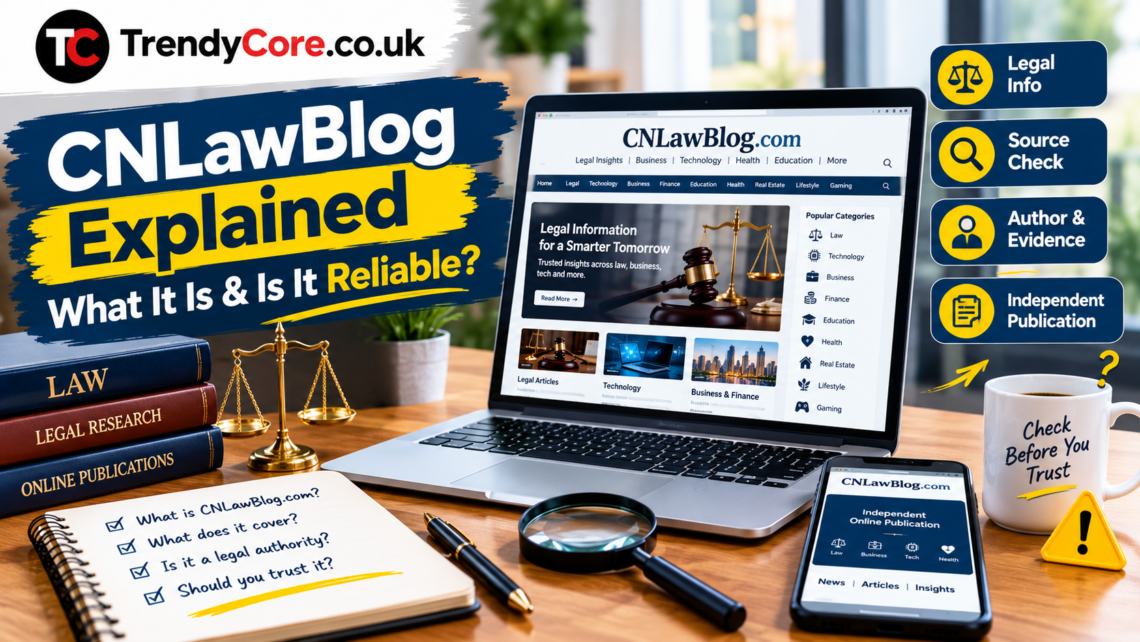
Type “cnlawblog” into Google, and you’ll get a flood of articles. Some call it a specialist China law resource. Others describe it as a sprawling lifestyle-and-finance publication. A few even call it “the leading multi-domain publishing platform.” They can’t all be right, and that’s exactly the problem this guide sets out to fix.
If you searched for cnlawblog expecting a quick, clear answer, you deserve one. This article cuts through the noise, checks the claims against what’s actually verifiable, and gives you a straight answer about what cnlawblog is, what it publishes, and whether you should trust what you read there.
What Is CNLawBlog?
CNLawBlog, more precisely the website cnlawblog.com, is a real, active online publication. Public domain-registration records place its creation around August 2018, and the site’s own About page states it started with a legal focus before expanding into broader subject matter.
That expansion is the key thing to understand. Today, cnlawblog covers far more than law. Its current content spans legal topics, finance, business, technology, education, health, real estate, lifestyle, and even gaming. In other words, cnlawblog now functions less like a dedicated legal resource and more like a general-interest content site that happens to have “law” in its name.
That naming choice is exactly why search results are so inconsistent. Some writers assume the name means the site specializes in law. Others, describing the current homepage, correctly note it’s now a multi-topic publication. Both descriptions have some truth to them, depending on whether you’re talking about the site’s origin or its present form.
Is CNLawBlog the Same as “China Law Blog”?
This is the single most important thing to clear up before going any further, and it’s where a lot of confusion online actually comes from.
There is a well-known, long-running publication called China Law Blog, hosted by the law firm Harris Sliwoski. That blog has been active since 2006 and focuses specifically on practical legal issues tied to doing business in and with China: trade, manufacturing, contracts, and international business law. It’s run by practicing attorneys and has built a reputation over nearly two decades.
CNLawBlog.com is a completely different website, on a different domain, with a different editorial model. It is not affiliated with Harris Sliwoski, and it is not a law firm. If you’re searching for authoritative guidance on Chinese business law specifically, the older, attorney-run China Law Blog is the resource you actually want. If you landed on cnlawblog.com instead, you’re looking at a separate, general-content publication that simply shares a similar name.
This distinction matters more than it might seem. Confusing the two could lead someone to treat general blog content as professional legal guidance, which is a mistake worth avoiding.
What Kind of Content Does CNLawBlog Publish?
Based on its current scope, cnlawblog.com organizes content around several broad categories:
- Legal topics — explanations of legal concepts, procedures, and general rights, written for non-lawyers
- Business and compliance — articles touching corporate regulations and practical business guidance
- Finance — general finance-related explainers
- Technology — pieces on tech trends, sometimes including AI-related topics
- Health and real estate — informational content in these areas
- Lifestyle and general interest — broader consumer-facing content
The legal writing tends to focus on accessibility. Instead of dense statutory language, articles aim to explain how laws function in everyday situations. That’s a reasonable goal, and it mirrors a broader trend across many independent legal information sites: making law less intimidating for readers without formal training.
Is CNLawBlog a Trustworthy Source for Legal Information?
Here’s where readers need to slow down and think carefully, because this is the part most competing articles gloss over.
CNLawBlog presents itself as an independent publication, not a law firm, court, or government agency. That’s stated plainly by the site itself, and it’s a critical detail. Independent legal blogs can be genuinely useful for building general understanding, but they are not a substitute for professional legal advice, and they generally aren’t held to the same standards of accuracy, licensing, or accountability that a practicing attorney or law firm is.
A few things are worth checking before treating any article on the site as authoritative:
- Author credentials. Is the writer identified? Do they have legal training, or is the piece written in a general blogging style?
- Sourcing. Does the article cite actual statutes, case law, or regulatory sources, or does it rely on general statements without backing?
- Recency. Laws change. An older article on a fast-moving legal topic may no longer reflect current rules.
- Scope of the claim. General explanations of “how a law typically works” are very different from advice tailored to your specific situation.
None of this means cnlawblog.com is unreliable by default. It means readers should treat its legal content the way they’d treat any general-interest blog: useful for background and orientation, not a replacement for a licensed professional when real decisions are on the line.
CNLawBlog at a Glance
| Factor | What We Found |
|---|---|
| Domain age | Registered around August 2018 |
| Current focus | Multi-topic: law, finance, business, tech, health, real estate, lifestyle |
| Legal authority | Independent publication, not a law firm or official source |
| Affiliation with “China Law Blog” (Harris Sliwoski) | None — separate, unrelated site |
| Best use case | General background reading and orientation |
| Not suitable for | Formal legal advice or decisions requiring professional counsel |
How to Use a Site Like CNLawBlog Responsibly
If you come across cnlawblog.com while researching a legal question, a few habits will keep you on safer ground:
- Treat it as a starting point, not a final answer. Use it to understand general concepts before consulting a professional for anything specific.
- Cross-check anything important. If a claim affects a real decision, verify it against a primary source like a government site, statute, or licensed attorney.
- Watch for the name confusion. If you’re specifically researching China-related business law, make sure you’re not accidentally reading general content instead of the specialized, attorney-run China Law Blog.
- Check publication dates. Legal and regulatory topics shift quickly; older posts may be outdated.
- Don’t skip a real consultation for high-stakes matters. Contracts, disputes, compliance issues, and anything with financial or legal consequences deserve a licensed professional’s input, not just blog-level explanation.
Pros and Cons
Pros:
- Free, accessible explanations of legal concepts for non-specialists
- Covers a wide range of practical topics beyond just law
- Written in plain language rather than dense legal jargon
- Active and regularly updated
Cons:
- Broad, general-interest scope dilutes its legal specialization
- Easily confused with the unrelated, more authoritative China Law Blog
- Not a licensed legal source; content should not replace professional advice
- Content depth and sourcing can vary between articles
Final Verdict
So, what is cnlawblog, really? It’s a real, independent online publication that started with a legal focus in 2018 and has since grown into a general-interest content site covering law alongside finance, business, technology, health, and lifestyle topics. It is not a law firm, and it is not the same as the well-established China Law Blog run by Harris Sliwoski.
Used correctly, cnlawblog can be a reasonable starting point for understanding legal concepts in plain language. Used incorrectly, mistaken for an authoritative legal source, it can lead readers astray on decisions that actually matter.
The smartest approach is simple: read it for orientation, verify anything important elsewhere, and bring in a licensed professional before making decisions that carry real legal or financial weight. That’s how you get the benefit of accessible content without the risk of treating a general blog as something it was never meant to be.
You may also Like: Is Alaikas.com Legit?